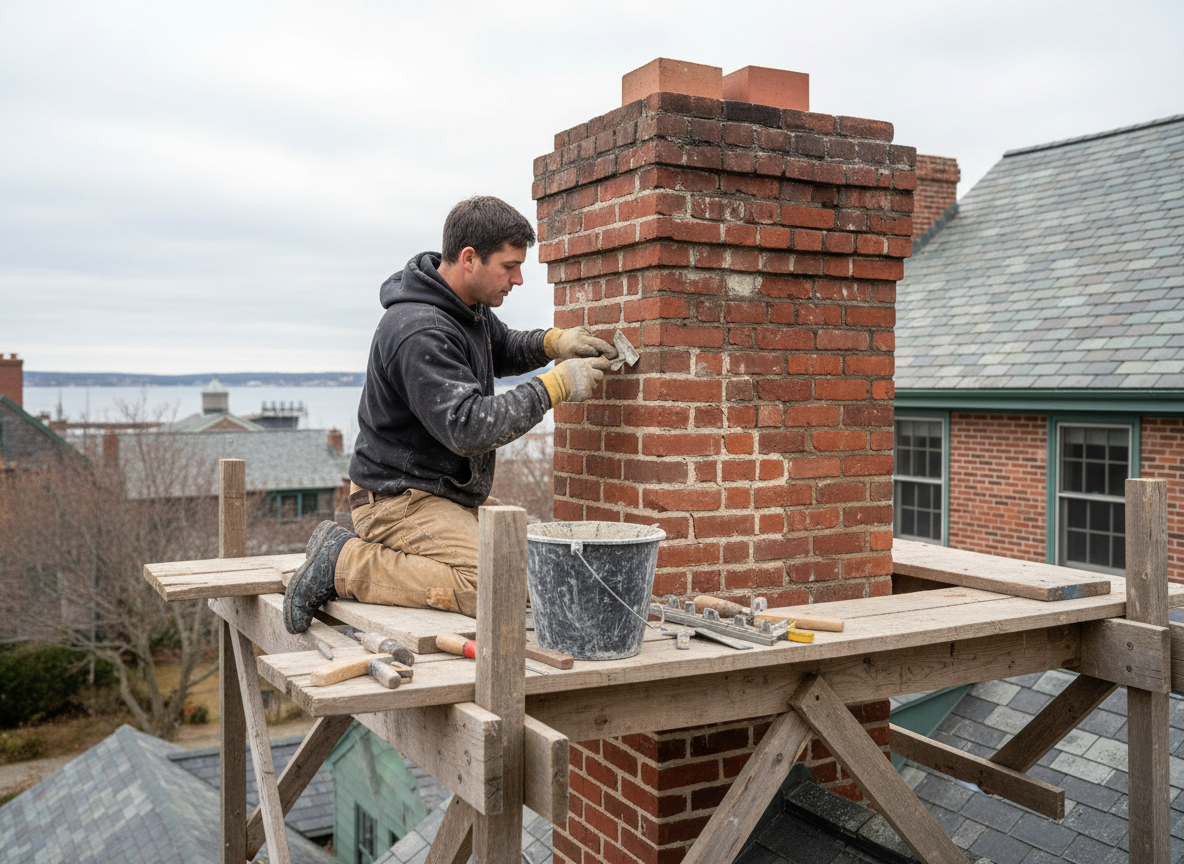
Tuckpointing involves cutting out failed mortar from brick joints and replacing it with fresh mortar matched to the original color and texture. In Gloucester City neighborhoods like Mount Ephraim and along the Delaware River waterfront, many homes built before 1950 have chimneys constructed with lime-based mortar that deteriorates faster under repeated winter freezing and thawing. Proper tuckpointing requires matching the original mortar composition to avoid trapping moisture inside the brick.
Homeowners often notice missing mortar or white efflorescence staining on the chimney exterior after heavy rains common in the Gloucester area. Ignoring these signs allows water to penetrate the flue liner and reach interior framing. Technicians must inspect for loose bricks and hairline cracks in the crown before starting, because tuckpointing alone cannot fix structural movement caused by settling soil near the river.
Work on Gloucester City chimneys frequently requires scaffolding when the stack rises above the second story of row homes. Technicians use hand tools to rake joints to a consistent depth rather than power grinders that can damage surrounding brick. The new mortar is tooled to shed water away from the joint face, a detail that becomes critical during the area's humid summers when trapped moisture promotes mold growth inside the chimney.
Code compliance in Gloucester County requires that any chimney work affecting the flue maintain proper clearance from combustible materials. Tuckpointing crews check that the flashing where the chimney meets the roof remains intact, because failed flashing is the leading cause of water entry even after mortar is restored.
Technician insight
In Gloucester, the thing that catches most people out with chimney tuckpointing is the older lime mortar in pre-war brick chimneys along the river; it fails faster than modern mixes because our freeze-thaw cycles push water deep into the joints before homeowners notice anything wrong on the ground.
Tuckpointing on a Gloucester City Row Home Chimney
The homeowner noticed white staining on the chimney after spring rains. Inspection showed eroded mortar on the north face and water tracking behind the flashing. We raked and repointed the joints with lime mortar matched to the original color, then resealed the flashing. The chimney now sheds water properly without further staining on the brick.
How it works
- 1
Initial Inspection
Technician examines the full chimney height from roof to foundation, noting joint condition, brick movement, and water staining.
- 2
Joint Preparation
Failed mortar is removed to a uniform depth using hand chisels while preserving the edges of the original bricks.
- 3
Mortar Application
Fresh mortar is packed into the joints in layers and tooled to match the surrounding profile and color.
- 4
Final Cure and Check
Mortar is allowed to cure under protective covering, then inspected for proper hardness and water shedding.
Pricing
Pricing depends on chimney height, number of sides accessible, and extent of joint failure; call for an upfront quote based on inspection.